
Federal Connecticut Release Paths
Federal custody serving Connecticut cases operates outside Fairfield Police and CT DOC. A sentenced federal prisoner usually appears in the Bureau of Prisons system. A person held before trial may instead be controlled through a federal detention order and U.S. Marshals arrangements, without the same kind of BOP sentence record.
Federal outcomes include release from BOP, federal supervised release, transfer to another jurisdiction, or continued custody outside BOP. “Not in BOP custody” describes the BOP status only. It does not rule out a state case, immigration detention, or federal supervision. The federal court docket explains the legal order behind the movement.
Search Federal Connecticut Releases
Use the official BOP Inmate Locator for sentenced federal prisoners from 1982 forward. Number search accepts a BOP Register Number, DCDC Number, FBI Number, or INS Number. A name search uses biographical fields. A unique number is safer than a name alone.
- Choose number search when an official identifier is known.
- Otherwise enter the name fields and narrow the possible matches.
- Confirm the register number, age, race, and sex shown in the result.
- Read the release date, location, and custody wording together.
- If the date is past and no facility is listed, treat it as release from BOP custody.
- Check the federal docket for bond, sentencing, judgment, or supervised-release terms.
BOP says its public records are updated daily. It also cautions that sentence recalculations under federal law can affect release dates, so readers should check again when a displayed date is still in the future.
Federal Court Release Records
The U.S. District Court for the District of Connecticut identifies PACER as the electronic public access service for case and docket information. Pretrial release often appears through a bond or detention order rather than the BOP locator. Sentencing judgments and later supervised-release proceedings also appear in the court record.
U.S. District Court for Connecticut
Federal case and docket information
PACER access for filed court records
Search the docket number when known. Relevant documents can include an order of release, detention order, judgment, sentence, commitment, or supervised-release action. U.S. Marshals custody movement is tied to those orders, while BOP is the public locator for sentenced federal imprisonment.
Federal Release Locator Fields
The BOP public result is narrow but useful. It is not a full criminal docket and does not publish booking photos. Match the federal identifier before treating the release date as belonging to the correct person.
| Field | Use |
|---|---|
| Register number | Unique BOP identity for the record. |
| Name and age | Biographical match checks. |
| Race and sex | Additional match fields in the public result. |
| Release date | Projected or past date reported by BOP. |
| Location | Current facility or no listed BOP site. |
| Custody wording | Released or not in BOP custody when shown. |
BOP explains that a past release date with no facility indicates the person was released from BOP on that date. Another criminal justice system or supervision authority may still have a role.
Federal Pretrial Release Checks
A federal defendant awaiting trial may be detained through the U.S. Marshals Service at a contract or local facility. The BOP locator may not supply the decisive status. The District of Connecticut docket is the better source for a detention hearing, bond, release conditions, plea, judgment, or remand.
- Pretrial release
- Release under a federal court order while the case continues.
- Remand
- An order returning or committing the person to custody.
- Judgment
- The filed court decision that includes the sentence.
- Supervised release
- Federal community supervision that follows imprisonment.
A person can leave a particular detention site without being released. Marshals may transfer the person for court, designation, medical care, or placement. Verify the court order before describing the movement as community release.
Federal Connecticut Source View
The District of Connecticut case-information page is the official route to federal docket access for Connecticut cases. The captured page below helps identify the correct court source.
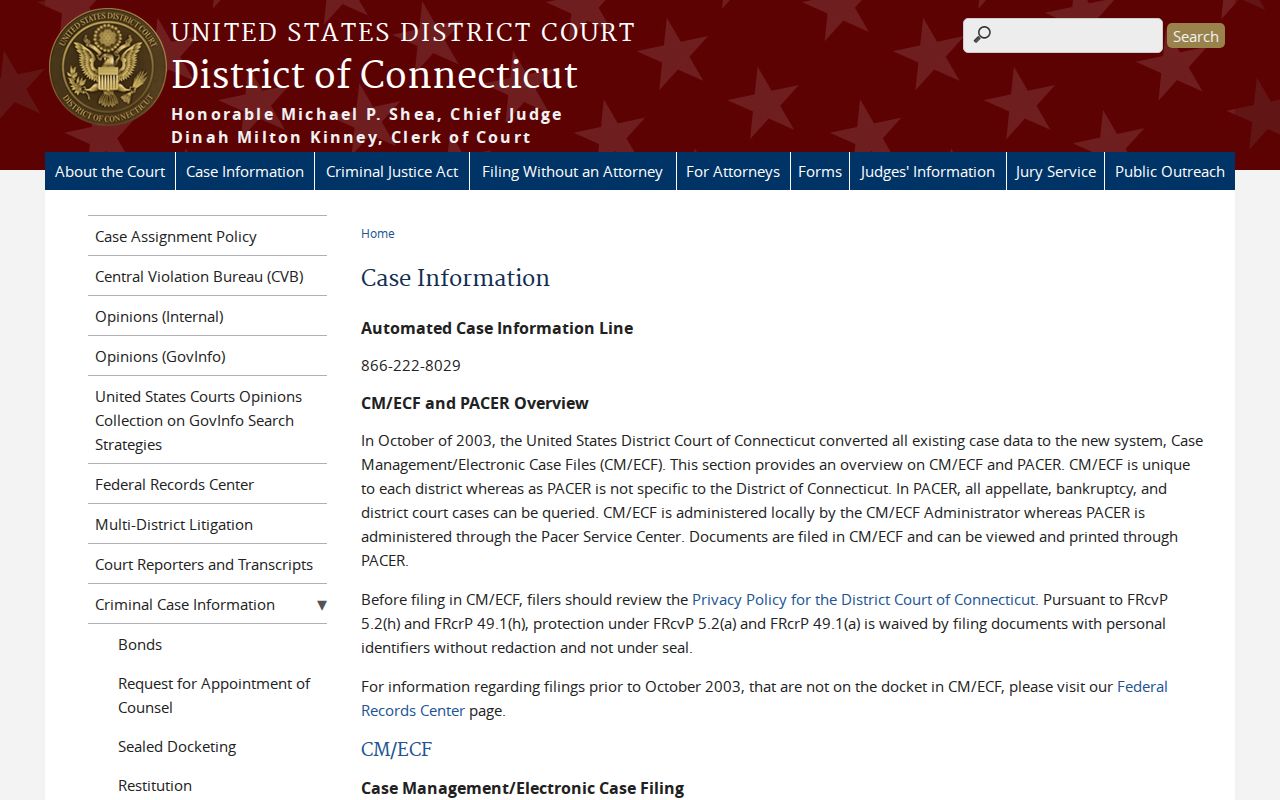
The federal docket complements the BOP locator by supplying bond, detention, judgment, and supervision orders.
Federal Release and ICE
A federal criminal release and an immigration custody decision are separate. A person can leave BOP or Marshals custody and pass to ICE. Search the ICE Online Detainee Locator System with the A-number and country of birth, or exact biographical information when the number is not known.
A BOP result showing release does not establish that ICE did or did not take custody. Likewise, ODLS does not explain the federal criminal judgment. Preserve both records. The federal docket and BOP record describe criminal custody; ODLS describes immigration detention within its current or recent coverage.
Note: Transfer to another authority is not release to the community, even when BOP no longer lists a facility.
After Federal Custody Release
Federal supervised release can begin after imprisonment. It is ordered by the court and administered through the federal probation system. It differs from Connecticut parole, special parole, and Judicial Branch probation. The judgment and later docket entries are the sources for its duration and conditions.
Other outcomes remain possible. A person may enter a state case, immigration custody, or another federal proceeding after leaving BOP. Search by the last known authority and avoid merging systems. For a Fairfield police arrest that never became federal, use the local report and Connecticut docket. For a CT DOC commitment, use the statewide inmate search. Federal tools belong only to the federal custody track. The Fairfield County release search compares those local, state, and federal routes.
Federal Record Confirmation
When the locator and docket appear inconsistent, compare dates and agency roles. A court may enter an order before a transfer is processed. BOP's public record can also change after a sentence recalculation. Save the register number and docket number, then ask the relevant office about the specific status fact.
A certified court filing is stronger evidence of the court's action than a search summary. The locator remains the practical source for BOP location and release date. Used together, these sources answer both parts of the federal release question: what the court ordered and whether BOP still reports custody.
Dates should be placed in sequence. Note the court order date, the BOP release date, and any later supervision or transfer entry. Different dates do not always conflict because an order may precede physical movement. If a federal locator result has no facility, use the docket to learn whether the next event was supervised release, another custody order, or a case action that needs confirmation from the issuing court.
Federal Locator Date Limits
The BOP locator covers federal inmates from 1982 forward. Earlier federal records require another archival route, and a person in state or immigration custody will not become a BOP match merely because the matter is serious. Check the prosecuting court and custody authority before choosing a locator.
BOP also notes that federal sentence recalculations can change dates. A future release field should be treated as the present calculation. A past date with no facility indicates release from BOP on that date under BOP’s own records explanation. Neither form tells the full story of supervised release, a state detainer, or an immigration transfer.
Federal Number Search Choices
Federal number fields are not interchangeable labels for the same agency. The locator accepts a BOP Register Number, DCDC Number, FBI Number, or INS Number. Enter the identifier in the matching field. If the only identifier available comes from a Connecticut police or DOC record, it may not be a federal number and should not be forced into the form.
A name search can return more than one person. Compare the register number, age, race, sex, release date, and location displayed by BOP. Record the exact match before opening the federal docket. PACER searches work best with a case number, and the BOP register number may appear in later filings but does not replace the court docket number.
Federal Release Order Sequence
Pretrial release begins with the court’s order and conditions. Sentenced release follows the judgment, BOP computation, and any later court action. Supervised release begins under the federal judgment after incarceration. Placing those events in sequence avoids mistaking a hearing date, order date, transfer date, and physical release date for one timestamp.
For a Connecticut federal case, the District Court docket can also show a revocation or modification after the original release. That later entry may explain renewed custody even when the original BOP release date remains accurate. Use the most recent relevant order, then confirm present custody with the agency that currently holds the person.