
Fairfield Parole and Probation Compared
Parole is a supervised release from a Connecticut correctional sentence. The Connecticut Board of Pardons and Paroles makes many parole decisions, while the Connecticut Department of Correction Division of Parole and Community Services supervises people in the community. Special parole is also linked to a criminal sentence, but it follows the terms imposed by the court and the governing statutes. A CT DOC result, parole docket, or board minute may show the transition from custody to supervision.
Probation starts with a court sentence or order. Fairfield cases commonly connect to the Judicial Branch and Court Support Services Division, often called CSSD. A docket may state probation, a suspended sentence, conditional discharge, or a violation of probation. Those terms point to the court and Adult Probation rather than to the parole board alone. A person can serve parole and later probation, or have neither form of supervision after release.
| Record question | Parole path | Probation path |
|---|---|---|
| Who creates the status? | Board or correctional authority | Sentencing court |
| Who supervises? | CT DOC Parole and Community Services | Judicial Branch Adult Probation / CSSD |
| Best public starting point | CT DOC status, BOPP docket or minutes | Court docket and probation order |
| Common change record | Grant, rescission, revocation, or termination | Violation, modification, discharge, or completion |
- Parole
- Supervised community release before the full correctional sentence ends.
- Probation
- Court-ordered supervision that may be imposed instead of, or after, confinement.
- Special parole
- A separate period of parole supervision ordered as part of a sentence.
- Discharge
- The formal end of custody or supervision under the issuing authority.
Check Fairfield Post-Release Supervision
Verification works best when it follows the case from court to custody and then to the current agency. A live custody result is not the same as a supervision record. Likewise, a person who no longer appears at Bridgeport Correctional Center may have transferred to another CT DOC facility instead of reaching parole. Match the name with a date of birth, DOC number, or docket number before relying on the status.
- Search the CT DOC inmate information system by DOC number when known, or by name and date of birth. Read both location and release information.
- Open the criminal case record through the Connecticut court lookup links. Look for probation, suspended sentence, conditional discharge, commitment, or violation entries.
- Check the BOPP hearing schedule and public meeting material when a parole grant, revocation, rescission, or early termination review is relevant.
- Use the assigned supervision agency for public-confirmable details. Parole questions go to CT DOC Parole and Community Services. Probation questions go to Judicial Branch Adult Probation.
- If the online record is unclear, request the court order, board minute, or DOC movement record that identifies the legal status and effective date.
A VINE alert can report a custody change, but it does not prove the terms of parole or probation. The Fairfield County release search on the home page explains how court, DOC, local, federal, and immigration custody sources fit together.
Note: Confirm the issuing agency before calling, because parole officers and probation officers do not hold the same case files.
Fairfield Parole Office Path
Connecticut Parole and Community Services lists district offices in Bridgeport, Hartford, New Haven, Norwich, and Waterbury. The Bridgeport district is the key local path for many Fairfield County releases. Assignment still depends on the person's home, release plan, and type of supervision. A release from Bridgeport Correctional Center does not guarantee that the Bridgeport district will keep the case.
The division also identifies specialized units for Fugitive Investigations, DUI cases, Women's Re-Entry, Central Intake, Residential Services, Special Management, Mental Health, Support Services, and staff training. Those units show why a district-office name alone may not tell the full story. The official Parole and Community Services page is the source for current office and unit information.
CT DOC Parole and Community Services24 Wolcott Hill Road
Wethersfield, CT 06109
(860) 692-6901
The 211 Adult Probation listing is a separate local route for court-ordered supervision. Research identifies Fairfield Adult Probation at One Lafayette Circle in Bridgeport. Start with the docket so staff can connect the inquiry to the right court and order.
Fairfield Parole Hearing Records
The Connecticut Board of Pardons and Paroles publishes a hearing page with changing video links. Hearings generally start at 9 AM unless the posting states otherwise. They may use Teams or Zoom and stream live. Links can appear on the morning of the hearing, so the page should be checked again near the listed date.
Hearing records can show more than an initial parole decision. The board uses outcomes such as granted, denied, continued, rescinded, revoked, and early termination review. A grant authorizes release subject to conditions and planning. A denial keeps the person in custody. A continuation postpones the matter. Rescission withdraws a planned release before it happens, while revocation addresses a person already on parole or special parole.
The State Agency Public Meeting Calendar can add an agenda, minutes, meeting purpose, and video-conference note. Minutes are useful when a live link has expired. This official calendar view shows the sort of event record that can explain a Fairfield parole decision after the hearing date.
The Board's public-facing schedule is visible on the Connecticut parole hearings page.
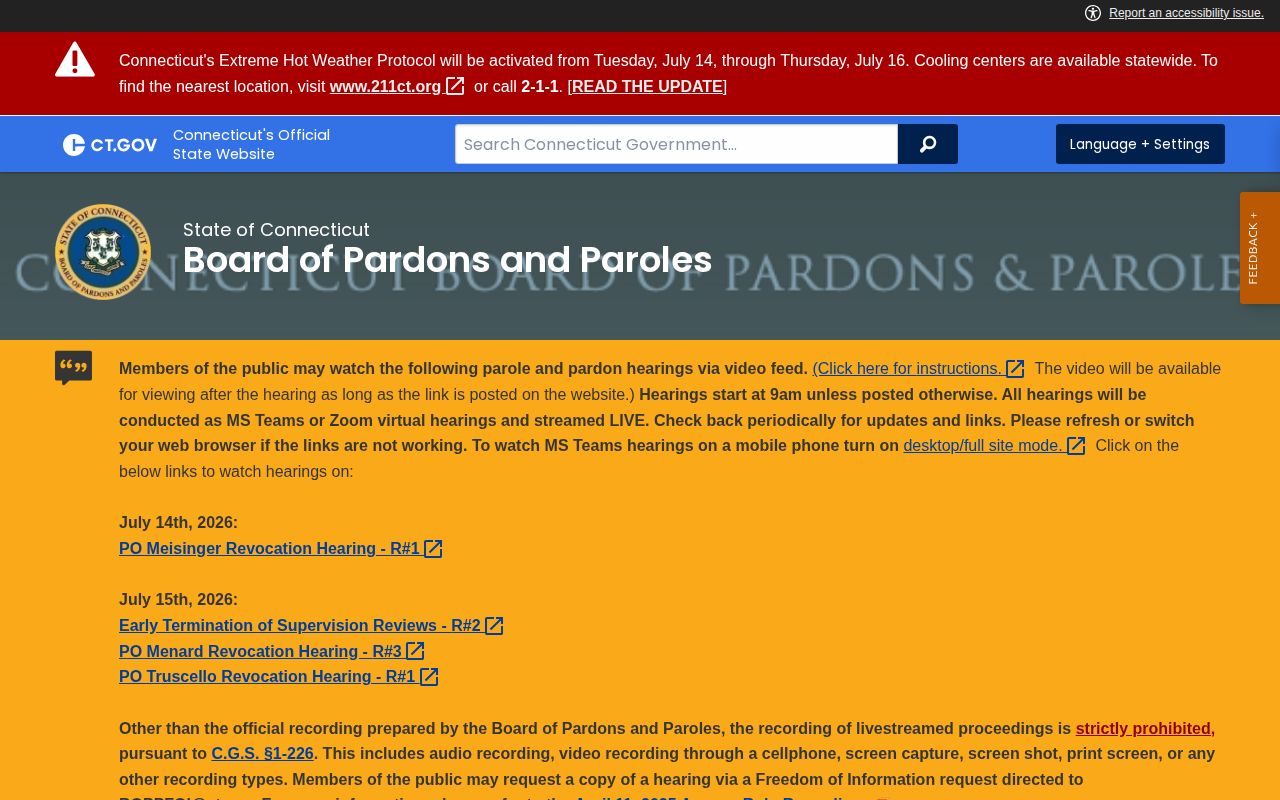
The screenshot illustrates the date-based hearing channel, which must be paired with minutes or the agency record when a final result is needed.
Fairfield Parole Eligibility Records
Eligibility is the right to be considered, not a release order. BOPP says that parole consideration generally applies to a person serving a definite sentence of at least two years and one day. The usual threshold is service of 50 percent of the total effective sentence, less qualifying jail or risk-reduction credits. Offenses involving the use, attempted use, or threatened use of physical force generally require 85 percent of the total effective sentence less jail credit. For covered offenses committed on or after July 1, 2013, risk-reduction credit does not reduce that 85 percent eligibility date.
The Board also identifies parole-ineligible offenses, while noting possible youth-offense exceptions under Conn. Gen. Stat. section 54-125a(f). A sentence length alone cannot establish the correct Fairfield parole date. Read the conviction, offense date, jail credit, and board record together. The BOPP parole eligibility page is the official starting point for those rules. If a person is eligible but no grant appears, the person remains in custody unless another lawful release path applies.
Fairfield Parole Reentry Support
Release supervision is not only a status entry. CT DOC says each correctional facility has a full-time reentry counselor, and the work grows more focused as release draws near. Counselors help coordinate the handoff from custody to services. Bridgeport-area resource material adds local service navigation for people returning from incarceration.
The CT DOC Offender Re-Entry Services page is the state starting point. The Bridgeport Reentry Resource Guide supplies the local layer. Neither source is proof that a person is on parole. They explain the support system that may accompany a Fairfield County release and help a released person find the office named in a discharge plan.
IDs After Fairfield Release
Identification and personal property can remain tied to the discharge facility after a person leaves custody. Connecticut's documented process uses a clear time split. During the first 30 days after release, the former inmate should contact the facility that discharged them. After 30 days, the route changes to CT DOC Reentry Services at Central Office.
211 Connecticut's identification guidance states that personal identification is secured at Central Office for two years. CT Reentry's statewide identification page gives the same facility-first and Central-Office-later division. This procedure is distinct from parole reporting. Still, acting on it promptly can help a released Fairfield County resident follow the reporting and service steps in the discharge plan.
Note: Contact the discharge facility first during the initial 30-day period, then use CT DOC Reentry Services after that point.
Fairfield Parole Absconder Records
An absconder is a person alleged to have stopped reporting or left supervision without authorization. It is not a label for every missed appointment, and a public tip channel is not a complete parole roster. CT DOC identifies fugitive-investigation routes for parole absconders, transitional-supervision escapees, and other high-profile cases.
The Parole and Community Services page lists its Fugitive Investigations Unit at (203) 346-7830. The CT.gov prison-system service page also lists the fugitive tip line at (860) 982-2372 and CT.FUGITIVE@ct.gov. These routes are for official reporting or verification, not for drawing conclusions from an old post or an unconfirmed name match. Urgent safety concerns should go to emergency services.
Ending Fairfield Release Supervision
Supervision can end through sentence completion, a board decision, early termination, discharge, or another order that changes the case. The final source depends on how supervision began. A parole or special-parole ending may appear in BOPP or CT DOC material. A probation discharge belongs to the court and CSSD record. A status that disappears from a public view should not be treated as proof of discharge.
Ask for the specific record that closes the supervision period: a board minute, termination notice, court order, or official DOC confirmation. Connecticut public-record access remains subject to exemptions, erasure, sealing, and other limits under Conn. Gen. Stat. section 1-210. If a record is restricted, the agency may confirm less than the requester expects.